1. Research Title
Perception on the role of Mass media in creating awareness on Cybercrime and National Security.
INDUSTRY: Academics Research.
Cybercrime is a growing global and national security threat carried out through digital devices, social media, and the internet. In Nigeria, popularly known as Yahoo Yahoo, it is driven by unemployment, poverty, corruption, and
the pursuit of quick wealth among youths. Cybercrime causes financial losses, weakens trust in digital transactions, discourages investment, and threatens national security, despite efforts by law enforcement agencies.
The mass media plays a vital role in raising public awareness of cybercrime through traditional and digital platforms. However, media coverage in Nigeria is often ineffective, as some reports sensationalize cybercriminals
while public understanding of the broader national security implications remains limited. In Abeokuta North Local Government, assessing public perception of media coverage is important for improving cybercrime awareness and strengthening national security.
ROLE: Research Analyst.
2. Research Problem
- Cybercrime is a growing problem in Nigeria, threatening economic growth, national security, and public trust in digital platforms.
- The rise in cybercrime has damaged Nigeria's global image and weakened confidence in online transactions.
- Despite frequent media coverage, cybercrime continues to increase.
- Common forms include Yahoo Yahoo, phishing, hacking, identity theft, romance scams, and banking fraud, with youths being the most involved.
- Some media reports have been criticized for glamorizing cybercriminals, making the crime attractive to young people.
- It remains unclear how residents of Abeokuta North perceive the effectiveness of media efforts in raising awareness and explaining security risks.
3. Research Objectives
- To assess residents' perception of the effectiveness of media campaigns in addressing cybercrime.
- To identify the types of cybercrimes most frequently reported by the mass media.
- To examine the extent to which the mass media have created public awareness about cybercrime among residents of Abeokuta North.
- To investigate residents' perception of the link between cybercrime and national security as presented in the media.
4. My Approach
- Created the research questions (questionnaire) using Google Suite.
- Exported the survey results from web into my MS Excel.
- Data cleaning and preparation.
- Exploratory Data Analysis (EDA).
- Import cleaned dataset into Tableau.
- Insights/Data visualization.
- Reporting/Recommendations.
TOOLS USED: MS Excel and Tableau
5. Key Deliverables
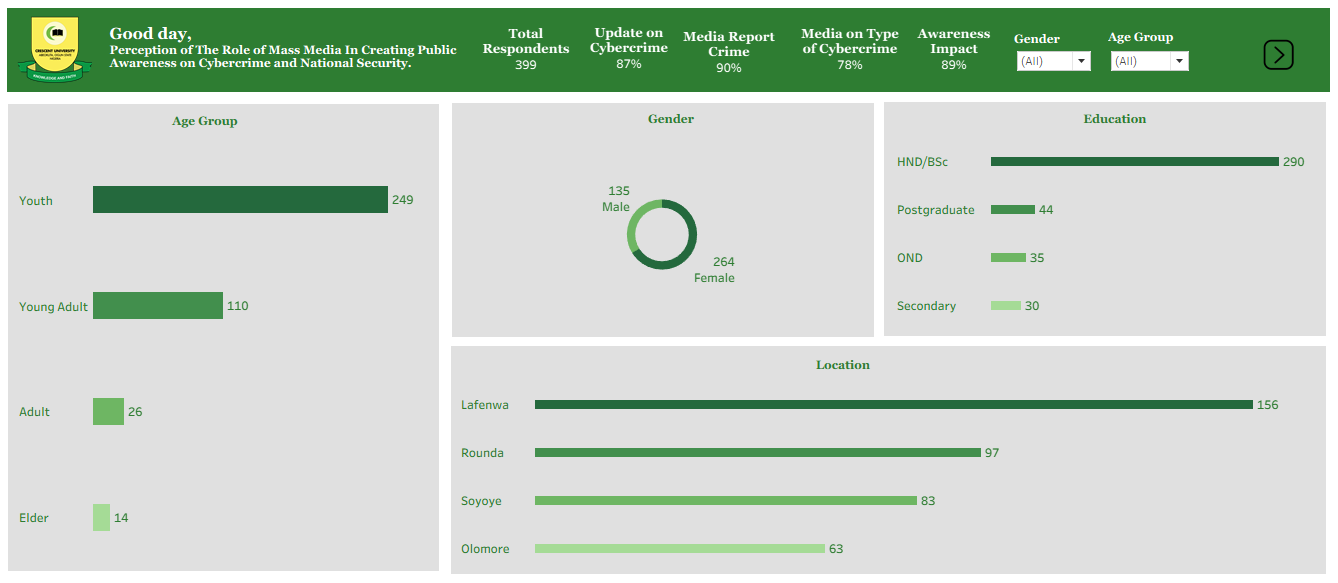
Delivered a Tableau dashboard to give insights to the survey.
6. Insights
MEDIA REPORT CRIME
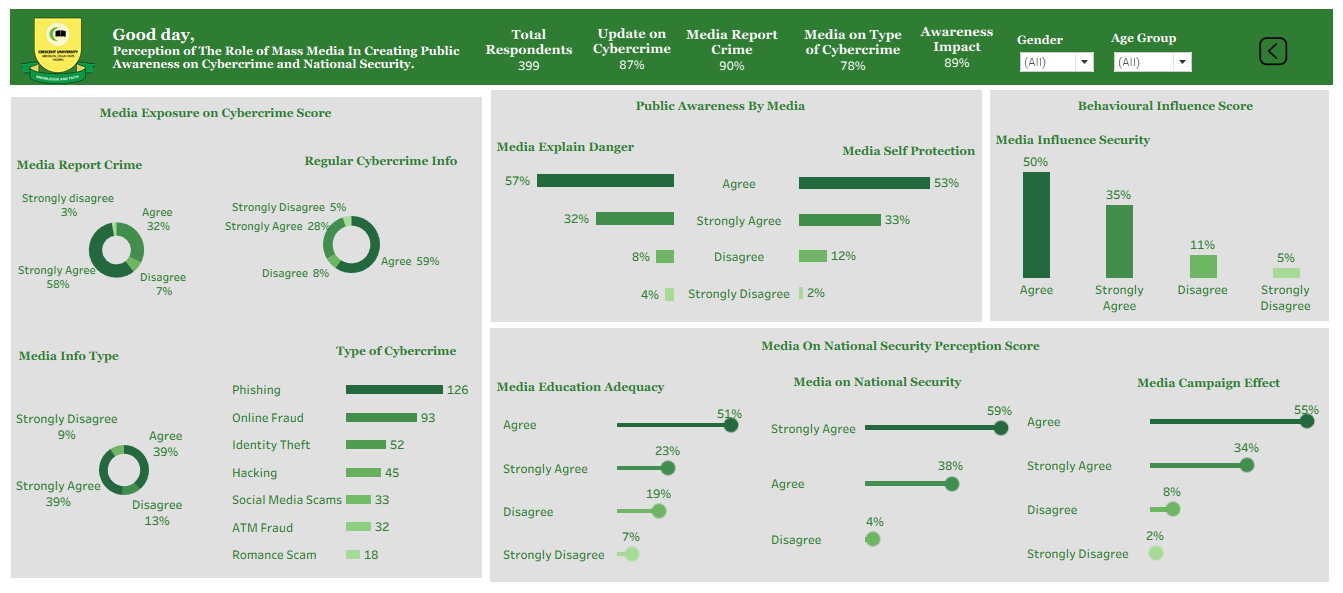
- 58% of the responders “Strongly Agree” and 32% “Agree” that the mass media frequently report news about cybercrime in Nigeria, making it a sum of 90% of the people who get informed via mass media, while 7% of the responders “Disagree”, and 3% “Strongly Disagree”.
REGULAR CYBERCRIME INFO
- 59% of the responders “Agree” and 28% “Strongly Agree” that they regularly receive information about cybercrime from radio, TV, newspapers, or social media, making it a sum of 88%, while 8% of the responders “Disagree”, and 5% “Strongly Disagree”.
MEDIA INFO TYPE
- 39% of the responders “Agree” and 39% “Strongly Agree” that the media provides enough information about different types of cybercrime (e.g. fraud, phishing, identity theft), making it a sum of 78%, while 13% of the responders “Disagree”, and 9% “Strongly Disagree”.
TYPE OF CYBERCRIME
- These are the number of the respondents have heard of the type of Cybercrime: Phishing (126), Online Fraud (93), Identity Theft (52), Hacking (45), Social Media Scams (33), ATM Fraud (32), and Romance Scam (18).
MEDIA EXPLAINS DANGER
- 57% of the responders “Agree” and 32% “Strongly Agree” that the media explain the danger cybercrime poses to individuals and society, making it a sum of 89% of the people, while 8% of the responders “Disagree”, and 4% “Strongly Disagree”.
MEDIA SELF PROTECTION
- 53% of the responders “Agree” and 33% “Strongly Agree” that the media messages help them understand how to protect themselves from cybercrime, making it a sum of 86% of the people, while 12% of the responders “Disagree”, and 2% “Strongly Disagree”.
MEDIA INFLUENCE SECURITY
- 50% of the responders “Agree” and 35% “Strongly Agree” that the media messages on cybercrime influence how seriously they take online security, making it a sum of 85% of the people, while 11% of the responders “Disagree”, and 5% “Strongly Disagree”.
MEDIA EDUCATION ADEQUACY
- 51% of the responders “Agree” and 23% “Strongly Agree” believe the media is doing enough in educating the public about cybercrime as a national security concern, while 19% of the responders “Disagree”, and 7% “Strongly Disagree”.
MEDIA ON NATIONAL SECURITY
- 59% of the responders “Strongly Agree” and 38% “Agree” that the media plays an important role in informing the public about threats to National Security, while 4% of the responders “Disagree”.
MEDIA CAMPAIGN EFFECT
- 55% of the responders “Agree” and 34% “Strongly Agree” that the media campaigns against cybercrime can reduce its occurrence in Nigeria, while 8% of the responders “Disagree”, and 2% “Strongly Disagree”.
7. Recommendations
- The data shows campaign effectiveness dropped from 89% to 74% in comparison to education adequacy suggests that while campaigns exist, their depth and clarity may be insufficient. This implies that residents see the effort, but not all feel fully educated. Media organizations should revise their methods and give a step-by-step cybercrime prevention education with real-life case explanations touching eg Phishing; Online fraud, and Identity theft.
- 78% Responder largely agree that the media reports on different types of cybercrime, which is lower 13% lower than the proportion of respondents who agree media reports crime (90%), and 10% lower than the proportion of respondents who regularly receive cybercrime information (87%). This could mean the media coverage on cybercrime are repetition. Media houses should diversify cybercrime reporting, improve consistency, and ensure balanced coverage of broader types of cybercrime: Financial fraud, Cyberstalking, and Data breaches.
- 89% Responder largely agree that the media explains the danger cybercrime poses to society, but 86% Responders agree that the media shows them how to protect themselves from cybercrime. This means the media is doing an accurate job in educating the public, but not enough on how to protect themselves; they should invite experts on Cybersecurity to review protective measures that can be carried out.